| Home | Newsletter | Locations | Diary |
|
Indexes |

|
|
|
Article Mute Swan
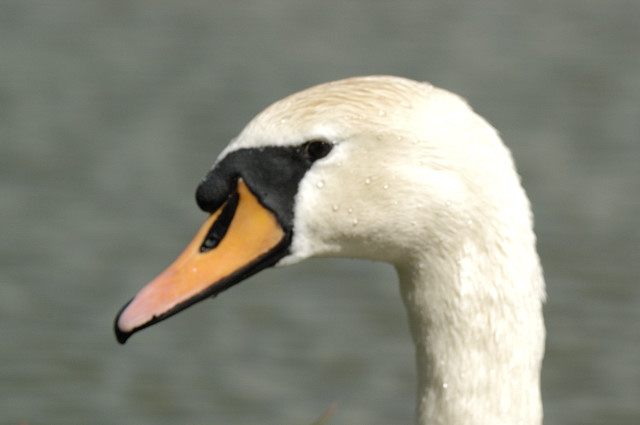
Mute swans are quite a common site within the UK, and can be seen on river banks, at canals and of course in the wetland centres. The mute swan is a very large white water bird. It has a long S-shaped neck, and an orange bill with black at the base of it. It flies with its neck extended and uses regular slow wing beats. When gliding through water they hold their necks in an s-shape formation with their bills pointing down, often also the wings are raised in the shape of a shield. The population in the UK has increased recently, perhaps due to better protection of this species. The ban on the sale of lead fishing weights has largely solved the problem of lead poisoning on lowland rivers. Some birds stay in their territories all year, while others move short distances and form winter flocks. In cold weather, some birds arrive from Europe into eastern England. The male, known as a cob, and the female (pen) birds usually attempt to mate for life, although it is not true to say that if one of the birds were to die the other would necessarily pine away. It is possible for an adult bird to find an alternative mate. The nest, built by the female, is a huge mound of material, normally dried grasses and assorted vegetation, sticks and rushes, constructed at the water's edge. It is a joint effort with the male supplying the materials. They use the same next each year, restoring and rebuilding where needed. The female lays up to six eggs, alternate days, between late April and early May. Incubation starts after the last egg has been laid and both parents will incubate them, they hatch after 35-41 days. The eggs weigh about 350g each and the newly hatched chick weights about 225g. The young birds called cygnets, sometimes ride on their parents' backs and remain with the adult birds for four or five months. Those from the earliest broods may start to fly in September. They are generally a dingy brown colour above and whitish below. Occasionally' cygnets may be all white and are then known as 'Polish swans'. They are territorial and the male will protect their young while on the water. The young of some pairs are driven off the breeding territory as soon as their plumage is predominantly white (during late autumn or winter). Other broods often accompany their parents to the wintering area, and usually join a large flock in which they remain when the parents return to their breeding territory. Young birds spend their teenage years in flocks where they find a mate before leaving to search for their own nesting site and territory, they will generally start to breed at 3-4 years old. Swans do not have any natural enemies, and are well equipped to defend themselves against predators, the main one being foxes. The main threats to their life come from pollution of freshwater areas, fishing tackle and overhead power lines that they sometimes come into contact with. Identification A large cob can weigh up to 15Kg and have a wingspan of up to 2.3m, the pen is slightly smaller. They typically range from 125 to 170cm long and may stand over 1.2m tall on land. One of the heaviest flying birds. It has a black and orange-reddish bill with black knob. The tail is long and sharply pointed. Unlike the other swans it is not as vocal, but has a warning call when approached, and hisses when using threat behaviour, most noise associated with mutes comes from their wings flapping when flying, which gives off a loud singing buzz with each wing beat.
Also See our other pages on Swans
|
||||||
|
||||||
| . | ||||||
|
||||||
|
|